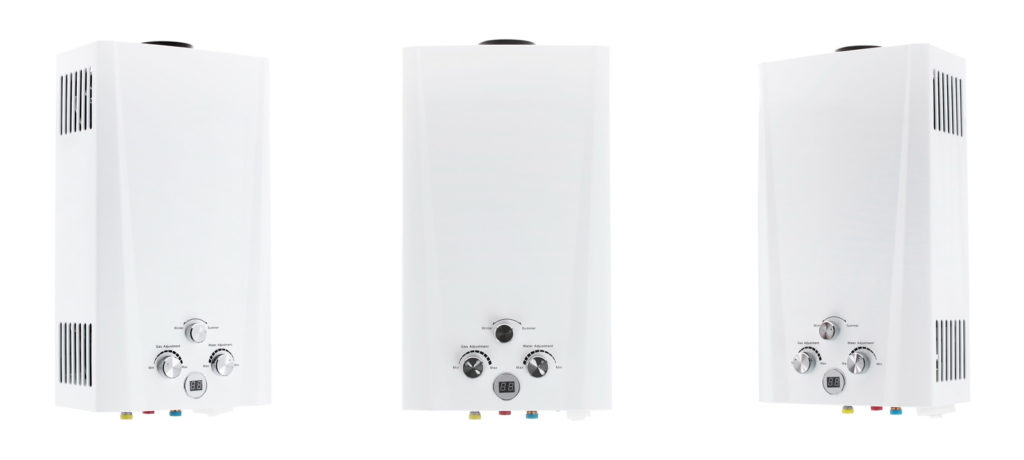
When replacing a water heater, you have two options: a conventional tank water heater or a tankless water heater. Tankless water heaters are newer technology, offering many convenience and energy-saving advantages. See how installing a tankless water heater can improve your hot water experience!
About Tankless Water Heaters
Tankless water heaters do not require a hot water storage tank – hence the name. They produce hot water on demand, when your taps are turned on. Versus homes using conventional tank water heaters, tankless water heaters offer potential energy savings of up to 34 percent. They also offer longer service life, lasting over 20 years with proper care (tank water heaters offer a service life between 10 to 15 years in most cases).
Tankless water heaters lower energy consumption by not storing hot water like a tank model does. Tank models require consistent energy consumption to keep stored water at the desired temperature. With a tankless water heater, you’ll avoid energy waste associated with standby heat loss.
Depending on the model of tankless water heater you purchase, you may be eligible for residential energy efficiency tax credits. Check with your tax professional to see if your tankless water heater qualifies you for this savings. Your local utility provider may also offer incentives for upgrading to higher efficiency water heating equipment – check with your provider for more information.
Electric Tankless Water Heaters
Electric tankless water heater uses electrical elements to heat water on demand. Electric models are cheaper to purchase than gas models. They also are typically cheaper to install as they do not require additional venting. Electric models are smaller than gas tankless water heaters, making them a smart choice in applications where space is limited.
The savings downside is the cost of electricity – in many areas, electricity is more expensive than gas. With the cost of electricity, heating your water may not generate quite the cost savings with electricity versus gas. But, electric models do not emit byproducts that are harmful to the environment like gas models do.
Electric tankless water heaters only supply about 5 gallons of hot water each minute. This is usually enough to meet the demands of a small family. It will not be adequate to supply multiple hot water demands at the same time. Electric tankless water heaters do not require maintenance.
Gas Tankless Water Heaters
Gas tankless water heaters are more expensive than electric models to purchase and install. Installation typically requires extra venting to accommodate the tankless water heater in your home. Additional venting is required for combustion emissions. If you purchase a condensing gas tankless water heater, a condensate drain system must be installed to accommodate condensed water.
Gas is typically cheaper than electricity, so heating water with a gas tankless water heater is more affordable for most homes than using an electric model.
Gas water heaters offer on average between 8 and 10 gallons of hot water each minute. This can supply multiple hot water needs at the same time and meet hot water demands for a larger family. Gas tankless water heaters require minimalannual maintenanceto preserve performance.
Your home is filled with endless chores: dishes, laundry, vacuuming and the dreaded task of dusting. While these duties are unavoidable, some of them may feel like they have to be done too often. If you’re struggling to keep up with a dusty home, it could be that your HVAC system is part of the problem.
Fortunately, for every common HVAC problem that may contribute to excessive dust, there is a simple and effective solution.
Set a Trap for Dust
When you’re checking your HVAC system for clues to the source of your dusty home, the filter is the place to start. HVAC filters should be inspected at least as often as once per month and replaced or cleaned whenever they’re dirty. If you have an especially dusty home or shedding pets, it may be worthwhile to replace the filter more often.
All the dust you see in your used filter is dust that is taken out of circulation in your home. But when the filter becomes clogged, your system can’t efficiently clean dust from the air, so more of it stays in your living space.
Not all filters are created equal, and you might find more success from filters with a higher MERV rating. Upgrading to these filters is a bit of a trade-off; the filters may last longer and will capture small particles that other filters won’t, but they’re more expensive and will cost you a bit in energy efficiency.
When changing your filter, you should also check to ensure that there’s a tight seal around all sides as it fits in the air return. If there are gaps or if your filter is improperly sized, dust will be able to flow freely through your system and throughout your home.
Plug the Leaks
Leaky ductwork is a somewhat more challenging problem that can cause excessive dust, and unfortunately, it’s very common. Small gaps can develop in your ductwork due to age, damage or poor workmanship, and they can develop in some very dusty areas of your attic and basement. These gaps allow dust to flow in at a point past your filter, and that dust goes right out your vents and into your rooms.
Take a close look at a few of your vents. If you see dust buildup on the fins or around the vents, you may have leaky ductwork.
Depending on the layout of your home and HVAC system, you may be able to safely inspect a good portion of your ductwork. If you turn out all the lights and inspect your ductwork with a flashlight, you can more easily see the flow of dust particles in the air, which can guide you to the source of a leak. Many small leaks can be effectively repaired with duct tape if you can reach them.
For more thorough inspections and repairs, consider enlisting the help of a licensed HVAC technician. They can detect and patch leaks in places you may not be able to reach, and those tend to be some of the dustiest parts of your duct system.
Don’t Dry Out
Homeowners in wetter climates tend to get a bit of a break from these dusty house problems, whereas those in more arid climates experience the opposite. Dust flows freely through dry air, and will therefore travel much farther through an HVAC system. When the air is more humid, dust settles faster and has more opportunities to get trapped in your filters.
Dust is not only a bigger problem in drier climates, it’s a bigger problem during the dry winter months than in the wetter summer. And if you have leaky ducts pulling in dry, untreated winter air from your attic, you might be creating an especially dust-friendly environment in your home.
Besides getting your ductwork sealed, the best weapon against overly dry air is to use a high quality humidifier in your home. If you live in a very dry area, it may be worth considering a whole-home humidifier, which can also help protect wooden furniture and trim from becoming brittle.
Dust Smart
These solutions may help you reduce the amount of dust in your home, but they won’t get you out of dust duty completely. So the next time you tackle this chore, try this trick: adjust your thermostat’s fan setting to “On”. If your filter is clean, it will trap a lot of the dust you kick up. Just remember to set it back to “Auto” when you’re finished.
When the average homeowner thinks about home heating, the furnace is probably the first appliance that comes to mind. But energy efficiency aficionados may think differently, because heat pumps -- which operate very differently -- can heat certain homes for a fraction of the energy cost. But which one is right for you?
First, let’s take a look at the basic differences.
How Furnaces and Heat Pumps Work
Most North American homes are heated with some type of forced air furnace, usually powered by gas or electricity. Gas furnaces feature sealed combustion chambers to generate heat, and electric resistance furnaces have electric heating elements similar to those in electric space heaters, only more powerful. In both cases, a fan circulates air over the heating elements and through a network of vents to heat a home.
Forced air heat pumps don’t produce any heat at all -- rather, they pull heat right out of the outside air, even if the air is cold. The heat is then condensed and pumped into the home through a fan system. There’s also another type of heat pump that uses geothermal energy; instead of salvaging heat from outside air, it gets heat from the relatively stable below-ground temperatures using a circuit of buried pipes.
Which One is Right for Your Home?
There are several factors to consider when deciding between a furnace and a heat pump, but the major factor is climate. In temperate climates with mild winters, heat pumps tend to be significantly more energy efficient than furnaces. But in frigid temperatures, heat pumps often struggle to keep up. Many systems have an auxiliary heat source that kicks in under these circumstances, but it’s far less efficient than a traditional forced air furnace.
Geothermal heat pumps are more resilient in colder climates, but they also cost significantly more to install than any other heating option, and there are some locations where installation is impossible. So the farther north you live, the more likely it is that a good old furnace is the most effective and efficient option.
If you do live in an appropriate climate for a heat pump, there’s another big benefit in addition to the efficiency gains. Heat pumps can also cool your home simply by working in reverse -- they pull hot air from inside the house and pump it outdoors. This allows you to heat and cool your home using a single unit, which can save you a lot when purchasing and installing a new system. It does, however, make maintenance intervals come around a little faster, since there’s just one system doing the work all year long.
Review Your Options With a Pro
If you’re not sure which system is right for you, a licensed HVAC technician can help you work through the decision. It’s best to consult experienced professionals about whether your climate is appropriate for a heat pump, as well as the difference between up-front costs and operating costs. In general, the up-front costs of furnaces are lower than forced air heat pumps and much lower than geothermal heat pumps, unless you also need a full duct network installed. But if you’re in a temperate climate, the low operating costs of a heat pump can more than make up the difference over time.
Colossal Green Electricity Plant Launches in Northern Cape
Spanish multinational Abengoa S.A. (MCE: ABG.B) recently launched its third solar thermal plant in South Africa. The power plant, Xina Solar One, is reportedly located near Pofadder, Northern Cape and has a total installed capacity of 100 MW. Many expect the plant to impact the local community and demonstrate the viability of renewable energy as a sustainable source of electricity.
Xina Solar One, the parabolic thermal installation follows the launch of KaXu and Khi and is one of the seven solar power projects planned under the Department of Energy’s Renewable Energy Independent Power Producer Procurement Programme (REIPPPP).
Dominic Goncalves, Vice-president of business development at Abengoa South Africa stated that Xina, and projects like it under the programme, have helped to solve South Africa’s energy crisis. He added that the new projects, using renewable energy would need to be developed and constructed in the future. He also added that the project delivered 1,800 jobs during the construction phase and is expected to create 80 permanent jobs during the operational phase over the next 20 years.
The thermal plant, known as a concentrated solar plant (CSP) reportedly uses parabolic mirrors to reflect the sun’s rays to a central tower hub which contains a salt. The salt reportedly melts under extreme heat, and the steam from the water is used to turn a turbine that creates electricity. Meanwhile, the International Renewable Energy Agency (Irena), states that the levelised cost of electricity from CSPs is higher than PV or wind systems. The agency also pointed out that the costs would be significantly less in high sunlight areas.
The CSP technology is relatively a new technology in clean energy production. And, in the context of developing CSPs where the key challenge is the state of the transmission network, Dr Matti Lubkoll, who teaches solar thermal energy at Stellenbosch University highlighted the contrast of the location of the projects and the availability of transmission lines. He also stated that with the deployment of CSP technologies maturity was likely to follow
Tesla App Allows Optimising for Cheaper Electricity
Imagine an efficient electricity system where if the electricity is expensive to generate you pay more, and if it is cheap then you pay lesser. This system would persuade ratepayers to conserve when the grid would be constrained and switch to using power when it’s clean and cheap, allowing savings on emissions and grid costs in the process.
Currently, the default electricity rates are quite inefficient in California, with increasing charges that are based on the energy one uses within a billing period.
In this context of inefficiency, starting 2019 California would be reportedly moving towards time-varying rates as the default. As opposed to the real-time rates, the time-varying rates (time-of-use rates) would have peak prices when electricity is expensive and in demand, and cheaper rates in off-peak hours. This would be a good way to also blend the intermittent renewables. So, a grid flush with solar power somewhere around mid-day would encourage ratepayers to use the electricity at that time, and avoid the usage later when the renewables would be scarcer.Meanwhile, Tesla app is offering an update that would allow its clients to optimise based on rates. The time-based controls update by Tesla, allows the customers to choose to store energy only for backup power, which allows maximising the amount of energy that gets generated by a rooftop solar system. The other time-based controls charging strategies include self-power, balanced time-based, and cost-saving time-based. After the sun goes down, the cost savings strategy is said to maximise consumer savings by using stored low-cost energy to power homes. And, when electricity prices are at its peak, the balanced time-based strategy is said to be used to power homes when electricity is expensive.
Homeowners with rooftop solar systems, in the near future, would want batteries to harness the cheap and clean power and offset the more expensive power later. And, with the new Tesla app which automates the process, it would be easy for clients to do this.
HVAC Energy Efficiency & Its Effects on Climate Change
The HVAC industry has continually worked to improve technology, increasing the energy efficiency of the heating and cooling systems in homes and businesses throughout the world. Not only do these advances bring energy saving benefits to users, but environmentally friendly heating and cooling technology is working to lower our impact on climate change.
Energy Saving HVAC Technology
As the HVAC industry strives to improve the energy efficiency of heating and cooling units, homeowners are now able to purchase units that increase energy savings by ultra-high efficiency ratings. ENERGY STAR rated HVAC units are available with SEER (seasonal energy efficiency ratio) ratings up to 27.5 for traditional central air conditions, up to 33.1 SEER for ductless units, and HSPF (heating seasonal performance factor) ratings up to 13.5 for heat pumps. Furnaces and heating systems are available with AFUE (annual fuel utilization efficiency) ratings up to 98.6.
The high energy efficiency ratings offered by new heating and cooling units mean systems utilize their fuel source more efficiently, consuming less electricity or gas. Higher efficiency units generate energy savings for homeowners, lowering utility bills and the cost involved with operating heating and cooling systems at home.
How HVAC Energy Efficiency Affects Climate Change
Higher energy efficiency ratings of heating and cooling equipment are working to lower impact on climate change. With more efficient utilization of heating and cooling fuel, less fuel is consumed. This lowers direct carbon emissions that impact climate change, as well as carbon emissions associated with the production of electricity and fossil fuels. With approximately 50 percent of a home or building’s energy consumption stemming from heating and cooling use, energy conservation through heating and cooling system use is especially impactful not only for energy savings, but for the environment and halting climate change.
Refrigerant evolution is also limiting HVAC systems’ impact on climate change. As R-22 refrigerant is phased out by the Montreal Protocol in favor of environmentally friendly R-410A refrigerant, homeowners will also see energy savings. In addition to being better for the environment and less damaging to the ozone layer that protects Earth against ultraviolet radiation to safeguard against climate change, R-410A refrigerant is more energy efficient, further helping cooling systems better utilize electricity for energy saving.
R-22 refrigerant used in HVAC systems manufactured before the phaseout finalizes in 2019 is an HCFC refrigerant, meaning it is composed of hydrogen, carbon, fluorine, and chlorine. The Environmental Protection Agency has determined this type of refrigerant causes damage to the ozone layer, contributing to climate change. Emissions from R-22 leak into the atmosphere through HVAC systems through refrigerant leaks. HCFC materials deplete the ozone layer and have contributed to the existing ozone hole over the planet’s South Pole.
Increase Energy Saving with HVAC.com
When looking to upgrade your heating and cooling systems for energy efficiency, HVAC.com is home to all the resources you need to make a smart, energy saving decision. In addition to our numerous HVAC resources, our HVAC Contractor Directoryhelps you locate trusted HVAC companies near you to perform the upgrades you need for energy savings. Simply search your ZIP code for a list of our Certified Contractors in your area who will be happy to help you implement energy efficiency technology for your home’s heating and cooling system.
The most confusing question we received that if two bulbs are connected in series and then in parallel, which one will glow brighter and what are the exact reasons? Well, there are lots of info around the web, but we will go in a very step by step details to calculate the exact values to clear the confusion.
First of all, keep in mind that the bulb having a high resistance and dissipate more power in the circuit (no matter series or parallel) will glow brighter. In other words, the brightness of the bulb depends on voltage, current (V x I = Power) as well as resistance.
Also, keep in mind that power dissipated in Watts is not the unit of brightness. Unit of brightness is lumens (denoted by lm which is SI derived unit of luminous flux) also known as candela (base unit of luminous intensity). But the light brightness is directly proportional to the bulb wattage. That’s why the more wattage a bulb is using will glow brighte
When Bulbs are Connected in Series
Ratings of bulbs Wattage are different and connected in a series circuit:
Suppose we have two bulbs each of 80W (Bulb 1) and 100W (Bulb 2), rated voltages of both bulbs are 220V and connected in series with a supply voltage of 220V AC. In that case, the bulb with high resistance and more power dissipation will glow brighter than the other one. i.e. 80W Bulb (1) will glow brighter and bulb (2) of 100W will dimmer in series connection. In short, In series, both bulbs have the same current flowing through them. The bulb with the higher resistance will have a greater voltage drop across it and therefore have a higher power dissipation and brightness.How? Let see the below calculations and examples.
Power
P = V x I or P = I2 R or P = V2/R
Now, the resistance of Bulb 1 (80W);
We know that current is same and voltage are additive in a series circuit but the rated voltage of bulbs are 220V. i.e.
Voltage in series circuit: VT = V1 = V2 = V3 …Vn
Current in series circuit: IT = I1 = I2 = I3 …In
Therefore,
R = V2 / P80
R80W = 2202 / 80W
R80W = 605Ω
And, the resistance of Bulb 2 (100W);
R = V2 / P100
R100W = 2202 / 100W
R100W = 484Ω
Now, Current;
I = V/R
= V / (R80W + R100W)
= 220V / (605Ω + 484Ω)
I = 0.202A
Now,
Power dissipated by Bulb 1 (80W)
P = I2R
P80W = (0.202A)2 x 605Ω
P80W = 24.68 W
Power dissipated by Bulb 2 (100W)
P = I2R100
P100W = (0.202A)2 x 484Ω
P100W = 19.74 W
Hence, proved power dissipated P80W > P100W i.e. Bulb 1 (80W) is greater in power dissipation than bulb 2 (100W). Therefore, the 80W bulb is brighter than 100W bulb when connected in series.
You may also find the voltage drop across each bulb and then find the power dissipation by P = V x I as follows to verify the case
V = I x RorI = V/RorR = V/I
For Bulb 1 (80W)
V80 = I x R80 = 0.202 x 605Ω = 122.3V
V80 = 122.3V
For Bulb 2 (100W)
V100 = I x R100 = 0.202 x 484Ω = 97.7V
V100 = 97.7V
Now,
Power dissipated by Bulb 1 (80W)
P = V280/R80
P80W = 122.32V / 605Ω
P80W = 24.7 W
Power dissipated by Bulb 2 (100W)
P = V2100/R100
P100W = 97.722V / 484Ω
P100W = 19.74 W
Total Voltage in the series circuit
VT = V80 + V100 = 122.3 + 97.7 = 220V
Again proved that 80W bulb is greater in power dissipation than 100W bulb when connected in series. Hence, 80W bulb will glow brighter than 100W bulb when connected in series
This guide has everything you need to know about your bathroom exhaust fans.
Benefits.
Types and costs.
And resources that cover everything related to bathroom fans.
In other words:
It's a one-stop-shop for homeowners looking to understand, purchase, and install their bathroom fans. From safety to odor control, there are many reasons whyhaving bathroom exhaust fans in your home are an essential necessity.
The primary purpose for having an exhaust fan is to remove the moisture out of the bathroom. These fans help to control and eliminate bathroom odors.
Additionally, they add to the safety of the home and its residents byreducing fumes from cleaning agents that could potentially cause health-related issues. Bathroom exhaust fans will help improve the quality of indoor air.
Benefits of a Bathroom Exhaust Fan
1. Eliminate Odors
One of the main reasons for having an exhaust fan is for odor control. If an unpleasant odor occurs in the bathroom, it can easily be drawn out with the help of an exhaust fan.
As a result, the ventilation system will enable you to keep your bathroom well maintained, while offering a clean atmosphere for the next person.
2. Humidity Reduction
Reducing the humidity in a bathroom is vital for its upkeep.Excessive moisture can wreak havoc on bathroom walls by causing paint and wallpaper to peel. In extreme cases, it can even cause doors to warp!
Most importantly, thehumidity can cause mold to accumulate. These spores can grow rapidly and can be difficult to get rid of. Therefore, it is crucial to have bathroom exhaust fans to prevent this from happening.
3. Reduce Airborne Contaminants
Bathrooms are typically cleaned with aggressive chemicals, which can cause a variety of health issues when inhaled. This is a major concern especially for small children, the elderly, or those with current lung conditions.
Additionally, if the bathroom is already experiencing a mold problem, the fan will help to remove the buildup of spores in the air. This, in turn, will also help to slow down the mold's growth rate.
4. Help Eliminate Foggy Mirror Syndrome
Bathroom exhaust fans will help control the moisture and remove water vapor on your mirrors and walls.
Chapter 2
Ventilation and Noise Considerations
Ventilation Requirements (Based on Numbers)
The need for proper ventilation and air movement is a relevant consideration in bathroom exhaust fans.
Air movement is typically measuredin cubic feet per minute (CFM), a standard measurement of fan airflow. HVI, Home Ventilating Institute, adds:
"Ventilationrates based upon eight air changes per hour are generally suggested. For mostbathrooms,this works out to one CFM per square foot ofbathroomarea. For example, a 7' x 10' bathroomwould require a 70 CFMfan.
For bathrooms between 50 and 100 square feet, estimate 1 CFM per square foot of floor space. For smaller bathrooms (less than 50 sq. feet), 50 CFM. For larger than 100 square feet, you have to tally the CRM requirement for each bathroom fixture to estimate your needs. Add 50 CFM for each toilet, tub or shower. And 100 CFM for jetted tubs.
Length x Width x Height x 0.13 = Minimum CFM rating
Most fans will be rated from 50 to 110 CFM.
Noise Level to Consider When Selecting Bathroom Fans
Sound levels in bathroom fans are rated in sones, not decibels. The sones rating is a measurement of how the sound is perceived by the listener.
The lower the rating number, the quieter the fan.
Hear the difference between the 4+ sones versus 2 sones.
Bathroom Exhaust Fan Noise Comparison
The best exhaust fan will offer two important features: quietness and remove moisture and odors.
Use the formula to best calculate the fan sizing that is appropriate for your space. From there, you can determine a sone rating. It's always good to have a fan that sucks out the most air at a lower noise cost.
Tip: Cleaning your unit helps with noise reduction. (See chapter 6)
Chapter 3
Features of Bathroom Exhaust Fans
Exhaust fans can be selected on the basis of your own style and overall performance.
Bathroom fan features in today's market can include, fans with lights, humidity/moisture sensing, and heat lamps.
The combination fan and light is common. There are products that offer a line of recessed fan/lights that will look like standard recessed lights. The ceiling exhaust fan is easy to install.
Have you ever left the upstairs bathroom fan on all day?
You have a choice to add a timed fan. Installing timer switches can help reduce mold build-up without wasting energy. Conservation Mart recently updated a post on Bathroom Exhaust Fan Timers: Perfect Solution for Forgetful People.It's a great solution to getting the benefit of ventilation and working efficiently.
In addition, there are moisture sensing switches to turn your fan on and off based on the humidity levels in the bathroom.
Your bathroom exhaust fan can be "smart". No need to have your fan run all day.
"A humidity sensor includes a manual fan switch, but if your sensor is set up correctly it should turn on and off based on the humidity in the room. With most sensors, you can also tell it how long it should run when it senses a certain level of humidity."
How to Install a Humidity Sensor in a Bathroom
Exhaust fans with heat lamps is also an option. Fan and heater can operate together or independently offering you ventilation and warmth if needed.
Chapter 4
Installation: Common Problems and Fixes
Although most homes come with exhaust fans already installed, not all of them are effective.
In order to get the most out of your bathroom fan, it is important to install one that will provide all of the necessary functions.
Common Problems With Installation to Avoid
Although there are many reasons for using bathroom exhaust fans, many people often fail to do so. In most cases, this is because the fan is loud and annoying. This is a common problem which occurs when the fan is not properly installed.
Poor installation also frequently involves a lack of insulation, which can cause heat to escape into the attic. Fortunately, all of this can be avoided with the appropriate exhaust fan and the proper installation.
The key to ventilation and installation is to guarantee the air gets brought outside. Older homes that have it vented into the attic can experience mold from moisture collecting.
For the Do-It-Yourselfer's, our friends at Lowes show,
If your manufacturer recommends the number of CFMs on square feet - use the formula: Length x Width = Square Feet. If your manufacturer recommends the number of CFMs on cubic feet - use the formula: Length x Width x Height = Cubic Feet.
And some will use the formula discussed in Chapter 2; Length x Width x Height x .13 = Number of CFMs (round up to nearest 10).
Step 2: Determine Where You Will Vent the Air
Your exhaust fan must vent outside.
Step 3: Understand Your Electrical Options
If you are not comfortable with this step, consult an electrician.
Step 4: Remove the Old Exhaust Fan
There are many steps and options to complete this section. Lowes lays out step-by-step instructions with images on your mounting options.
Option 1 involves mounting the exhaust fan with attic access.
Option 2 involves mounting without attic access.
Decide which suits your current situation.
Bathroom exhaust fans are a crucial element that should not be overlooked in your home. It is important that you install an exhaust fan of high quality, that way you can rest assured knowing you made a smart investment.
Chapter 5
Efficient Bathroom Exhaust Fans
ENERGY STAR®, is the "government-backed symbol for energy efficiency, providing simple, credible, and unbiased information that consumers and businesses rely on to make well-informed decisions."
Earning the Energy Star means the "product meets strict energy efficiency guidelines set by the US Environmental Protection Agency."
One of the certified products they suggest is the Greenheck SP-80-VG as one of the premium plus bath fans.
According to Energy Star, "This fan utilizes an EC motor that is extremely energy efficient and allows the installer to balance the fan to precisely meet the ventilation demands of a given space." [source]
This provides better efficiency and comfort with less noise.
It also includes lighting, three speeds, and 0.3 sones rating. Installing acceptable ventilation will help control moisture and remove foul odors.
Simple Toilet gathered the best exhausting fans for 2018. They conducted a survey and scoured over customer reviews to come up with their list - Best Bathroom Exhaust Fans Reviews & Guide.
The factors considered to make the list:
airflow capacity
special features
style and color
level of noise
budget
Chapter 6
Care and Maintenance of Fans
Is it time to clean that neglected bathroom exhaust fan?
If you see dust on the fan, you are long overdue. If you notice more steam than usual on the mirror, you are long overdue.
Need a quick test to see how efficient your exhaust fan is working?
Hold a piece of toilet paper up to the fan. If it's getting sucked up by the fan, it's still working.
Having a clean and functional fan in your bathroom is just as important as any other cleaning job in your home. (washing machine, refrigerator, etc.) Stop putting the task off.
Airflow and exchange are necessary. Deep clean your fan at least once a year.
10 steps to follow for a dirt-free, mold-free fan:
Step 1: Turn the fan off at the circuit breaker or switch. No electricity allowed.
Step 2: Remove the cover. Pull the fan cover down gently. If there are metal pins/spring clips on each side, squeeze gently to release the fan cover. You may see just a tab depending on the model.
Step 3: Wash the fan cover in a sink with soap and warm water. Or vacuum to clean the vent cover.
Step 4: Unplug the fixture.
Step 5: Depending on the model of your fan, remove visible screws and motor. (we are going in for a deep cleaning)
Step 6: Clean the fan blades and surrounding motor parts with a damp cloth. If you are not comfortable taking the motor out, you can just vacuum inside the fan housing and around the motor.
Step 7: Clean the exhaust vent and surrounding area. Let everything dry out before replacing your vent cover.
Step 8: Reinstall your exhaust fan.
Step 9: Turn the electricity back on.
Step 10: Enjoy a cleaner, more efficient exhaust.
Need a visual?
Our friends at One Good Thing, give you a step by step with images and all.
Conclusion
If you take care of your bathroom exhaust fan, it will take care of your bathroom’s air.
Your home consists of heating and air conditioning systems that are essential to the comfort and well-being of your home and goes well beyond your bathroom.
Ventilation is part of HVAC (heating, ventilation, and air conditioning) that provides comfort and good air quality. It's important to choose an HVAC company that understands correct ventilation as well as heating and cooling.